
Your Custom Text Here

MINDSET – Mapping, Visualisation, and Mental Models with Eli Montgomery and Rosemary King
In the latest episode, Rosemary King, our Director of Training Products welcomes Eli Montgomery to Mindset. Eli is currently Head of User Experience at Cazoo, a platform transforming the way people buy used cars. He is also a Mind the Product trainer, teaching our one-day workshops.
Rosemary and Eli discuss mapping, visualisation, and mental models and draw from their own experiences and expertise to answer questions from the Mind the Product community. They also discuss our latest workshop – Mapping for Product Managers. Find more information about these workshops and where we are running them.
In the latest episode, Rosemary King, our Director of Training Products welcomes Eli Montgomery to Mindset. Eli is currently Head of User Experience at Cazoo, a platform transforming the way people buy used cars. He is also a Mind the Product trainer, teaching our one-day workshops.
Rosemary and Eli discuss mapping, visualisation, and mental models and draw from their own experiences and expertise to answer questions from the Mind the Product community. They also discuss our latest workshop – Mapping for Product Managers. Find more information about these workshops and where we are running them.
MINDSET Series: Being Empowered To Manage Your Stakeholders With Papa Akuffo
Rosemary King welcomes Papa Akuffo to Mindset. Papa is currently Product Management Lead at Ideo. He previously held senior product roles at Pivotal Labs.
In this episode, Papa and Rosemary discuss stakeholders, the importance of qualitative, human data, and draw from their own experiences and expertise to answer questions from the Mind the Product community.
Rosemary King welcomes Papa Akuffo to Mindset. Papa is currently Product Management Lead at Ideo. He previously held senior product roles at Pivotal Labs.
In this episode, Papa and Rosemary discuss stakeholders, the importance of qualitative, human data, and draw from their own experiences and expertise to answer questions from the Mind the Product community.
Speaking with Director of Product Management and IDEO
Product Management Series: Rosemary King, Director of Training Products at Mind The Product
Rosemary is an experienced product manager who has specialized in software development, agile enablement and lean methodologies for the past seven years. She has worked across diverse domains including government, finance, retail and enterprise.
After starting her tech career in the New York City start-up scene, she moved into consulting and has spent time with ThoughtWorks and Pivotal Labs London.
She has done freelance consulting and training with incubator programs like start-up bootcamp, done UX research on four continents and likes cold water surfing. You can usually find her at monthly ProductTanks in London.
1:44 - How has product management evolved as a skill-set over the last 5-10 years?
2:24 - What advice would you give to help product people manage stakeholders?
3:40 - How do you audit a product and a team in a short period of time?
4:49 - How do you best introduce change to a product organisation?
6:15 - What advice would you give to someone looking to get into product?
8:47 - How do you encourage leaders to let go and empower them?
10:01 - What have you learned since start Mind the Product?

Stakeholders, let ‘em in
Rosemary King educates us on the importance of involving stakeholders (especially those in senior positions) in the research phases of your products.
Collaboration
Collaboration is important. As a product manager you enjoy being in control, but at times this control can be detrimental to a product. Rosemary cites a number of examples where collaboration with stakeholders is important: they may have specialist knowledge you don’t have; you need to keep them on the same page in terms of project goals; you need to ensure multiple points of view are taken into account, and much more.
View the talk here.
Who are They?
In this case stakeholders are people who can delay, change or cancel your project. As product manager, it’s your job to get them in the room and to understand why research is important. If senior stakeholders don’t understand or haven’t been involved in the research, all you have is your opinion against that of the HIPPO (Highest Paid Person’s Opinion) and chances are that you will lose.
When do you Need Them?
Including stakeholders is important – especially early in the project, but ultimately you need to get some work done as well. They should be included in setting goals, to keep everyone on the same page; They should attend some user interviews to get first-hand experience of the issues facing real users; They can also attend standups and retrospectives to keep up to date with the project.
It’s the Group
You should be communicating with stakeholders as a group, rather than one on one. This way all viewpoints are heard, rather than being heard all through you, so feedback won’t lose perspective.
How?
How do you get stakeholders involved? Rosemary’s advice includes ensuring that they understand what the meetings are for and that they understand what you expect their contribution to be; She suggests you create roadmaps for the research and mark down when you expect people to be involved, and that you sure that meetings are scheduled and don’t move; You should follow up with action points from the meetings; and if nothing else works to get the stakeholders in the room, get the HIPPO on board to help.
Panel: The first 90 days as a Product Leader

Mind the Product Leadership Panel: San Francisco 2018
Leadership Forums are not filmed so that participants feel free to discuss topics openly and honestly.
The following Monday, I attended the Mind the Product (MTP) Leadership Forum, which was a forum on all things in the product management leadership space.
At the MTP Leadership Forum, some very similar themes came up. There was a panel on the first 90 days as a product leader with insights from Chris Abad, David Bland, Rosemary King, Marc Abraham, Stephanie Hannon below:
It is perfectly ok (and advantageous) to be less visible in the first couple of months and be in listening mode. You don’t want to come in with a bang and shake things up in your first couple of months as a product leader. You should be spending 80% of your time listening (a listening tour), 20% sharing and synthesizing what you have heard. It is important to understand how people perceive product development at your organization. Admitting what you don’t know does not make you less of a leader, ask why and how things are the way they are. I’ve noticed this is very effective in past roles, though oftentimes you are pressed for the answer. It is ok to push back and say that you want to understand context before making brash assertions that may not be founded on correct assumptions.
Conflict is ok as long as there is psychological safety. Creating an environment of psychological safety was a common team across the two conferences, often times referencing the NY Times article on Google Teams. There are several ways to foster this environment: give people opportunities to provide feedback in a structured way through weekly retrospectives (this is something I practice with all my teams), trick people into talking to each other even across levels. Kate Leto had insights on how to de-escalate conflict: it is ok to have a “beef” session for a cross-functional team, but start with the easiest challenge first to build some momentum. She recommended using a framework called Nonviolent Communication by Marshall Rosenberg. As an aside, I also recommend this book, it has deepened many of my relationships and made me a more skilled conflict resolver. One other way I’ve found to resolve conflict is to admit that there was a past wrong, and commit to working together, the act of co-creation of future work is a powerful bonding and healing experience for cross-functional teams (for example co-creating a service design blueprint).

Get back to play: How Play and Playfulness can help build better Products
As children, we played in order to learn about the world around us and press against our growing boundaries. We took wild journeys of fantasy where every object in front of us had possibilities. This concept of child-eyes essentially means abandoning our ingrained assumptions about the world around us and seeing something with a sense of innocence. This talk will cover the concept of play as a cognitive developer, examine case studies where play and imagination contributed to amazing product design, and give some ideas as to how we can continue to do this with our team and on our own everyday to help strengthen our play muscles.
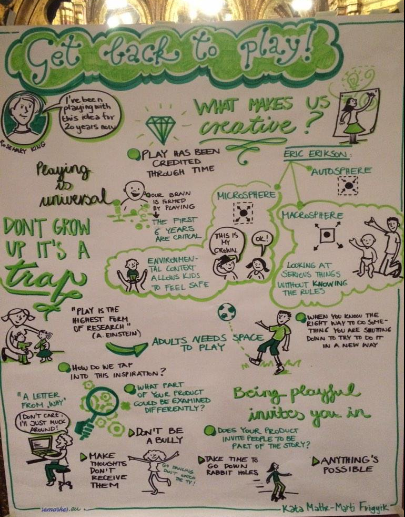
As children, we played in order to learn about the world around us and press against our growing boundaries. We took wild journeys of fantasy where every object in front of us had possibilities. This concept of child-eyes essentially means abandoning our ingrained assumptions about the world around us and seeing something with a sense of innocence. This talk will cover the concept of play as a cognitive developer, examine case studies where play and imagination contributed to amazing product design, and give some ideas as to how we can continue to do this with our team and on our own everyday to help strengthen our play muscles.
You can view the talk here.
Blog mentions:
http://workcompass.com/top-takeaways-stretch-leadership-conference/
http://tech.kinja.com/8-takeaways-from-stretch-conf-2014-1667913317
Introducing Enterprise companies to Balanced Team techniques
Over the past years, I've worked with a bunch of big enterprise companies who want to "do agile" development. In my experience, it's best to try to shift that expectation from "doing agile" to "being agile." Intrinsic in that philosophy are teams that have seamless communication through various disciplines.
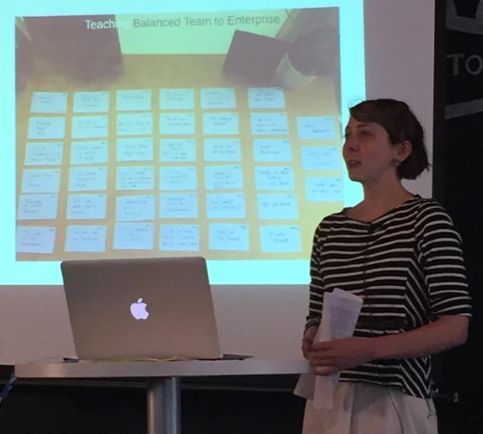
Over the past years, I've worked with a bunch of big enterprise companies who want to "do agile" development. In my experience, it's best to try to shift that expectation from "doing agile" to "being agile." Intrinsic in that philosophy are teams that have seamless communication through various disciplines.
As we bring in small corporate teams to work with us on projects, the biggest eye opener for them is what happens when you break down the walls. So we as teachers have to work in our balanced teams with an eye toward teaching and demonstrating. It's got to be balanced teams x10. I'd like to talk about this process, the challenges that come with having to be our highest selves, what the corporate teams have the hardest time with, what processes we use to bring them onboard, and what happens when they leave the nest and go back to their offices.
Click here to check out the talk.

Playing into Great Product Ideas
Given at User Conf London 2015A more focused talk on playful products and how product managers and companies can think about using games and creativity to engage their users.

Given at User Conf London 2015A more focused talk on playful products and how product managers and companies can think about using games and creativity to engage their users.
Avoiding User Interview Pitfalls
Talking about the common mistakes that teams make when executing user research, a common pattern is not allowing a enough space and silence around the user to allow their feedback to come through loud and clear. I call out these anti-patterns and offer tips that will help new researchers avoid them.
Rosemary King, talking about the common mistakes that teams make when executing user research, a common pattern is not allowing a enough space and silence around the user to allow their feedback to come through loud and clear. Rosemary will call out these anti-patterns and offer tips that will help new researchers avoid them.

Maintaining Continuous Learning Under Pressure
This joint presentation by Pivotal Labs Product Manager Rosemary King, and UX Designer Simon Phillips will explore why up front investment in Discovery and Framing set up a project on solid foundation, how to react when unknown unknowns throw off the product plan, how to involve development teams in the exploration and synthesis process, and how to set a cadence for your UX design work so that a comfortable buffer exists to allow for continual evolution of the product based on user feedback and changing understanding. Baked into the presentation will be case studies, challenges and lessons learned on recent lean/agile projects.
This joint presentation by Pivotal Labs Product Manager Rosemary King, and UX Designer Simon Phillips will explore why up front investment in Discovery and Framing set up a project on solid foundation, how to react when unknown unknowns throw off the product plan, how to involve development teams in the exploration and synthesis process, and how to set a cadence for your UX design work so that a comfortable buffer exists to allow for continual evolution of the product based on user feedback and changing understanding. Baked into the presentation will be case studies, challenges and lessons learned on recent lean/agile projects.